

Carbon Exchange Officially Launches—A Strategic "Puzzle Piece" in the Green Finance Ecosystem
This morning (June 29, 2026), the domestic Carbon Exchange was officially launched and began operations. With a total allocated quota of over 51.7 million credits on its first trading day, this event not only marks a historic technical milestone but also formally establishes a core economic tool to help businesses optimize costs, enhance their competitiveness, and fulfill Vietnam’s commitment to achieving “Net-Zero” emissions by 2050.
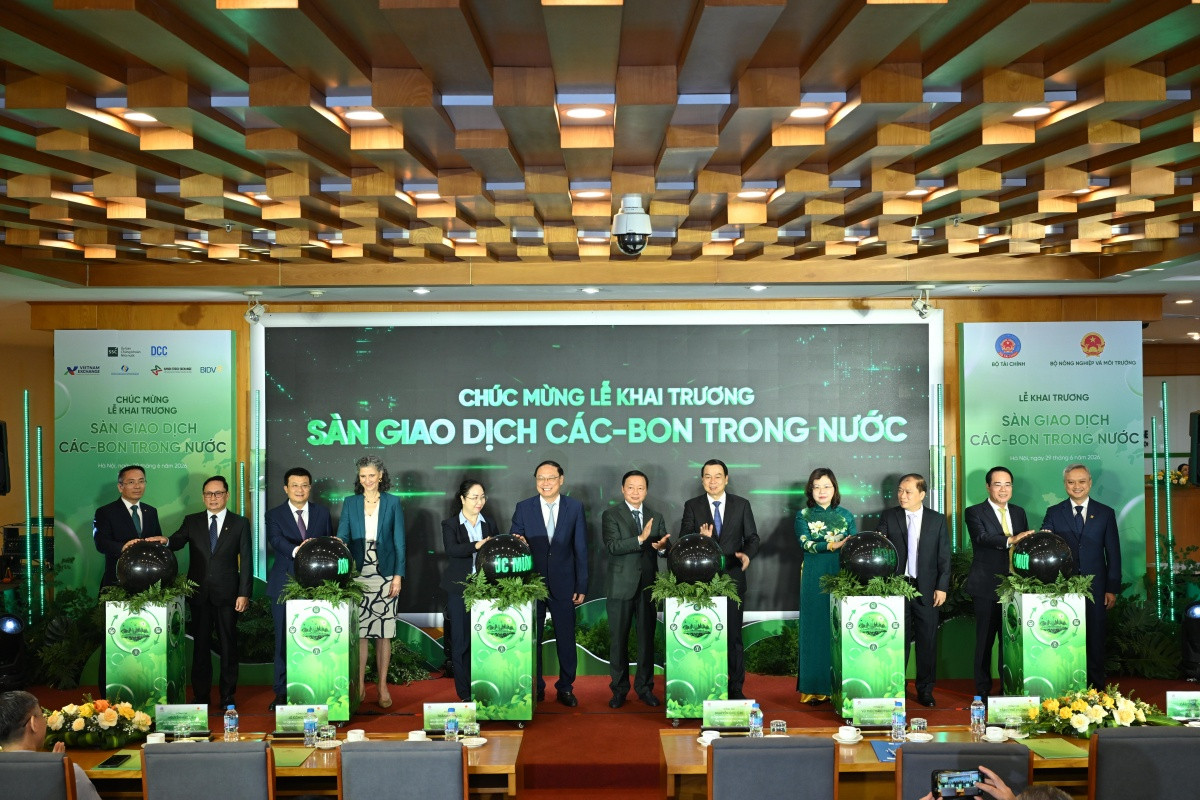
Speaking at the launch ceremony, Mr. Nguyen Anh Phong, Chairman of HNX, emphasized that bringing the market online was the result of close collaboration between HNX, VNX, the State Securities Commission (SSC), the Department of Climate Change, VSDC, and BIDV Bank. To date, the information technology system connecting the regulatory bodies, depositories, and the designated settlement bank, BIDV, has been successfully tested, ensuring stable and seamless operations.
The market launched with a membership system comprising six securities firms that fully meet the participation requirements, along with more than 100 emitting entities included in the quota allocation list. On the electronic board during the first trading day (June 29, 2026), the total allocated quota was displayed at 51,730,846 carbon credits.
Mr. Nguyen Anh Phong emphasized that the launch of the carbon exchange is not merely a technical step, but holds significant importance in linking environmental protection responsibilities with the economic interests of businesses themselves. This is a market-based mechanism that allows businesses to proactively optimize costs and minimize emissions through the trading of allowances and credits, thereby resolutely pursuing the goal of not sacrificing the environment for economic growth.
Free trading through 2028—a major “boost” for businesses transitioning to green practices
In her keynote remarks at the ceremony, Ms. Vu Thi Chan Phuong, Chairwoman of the State Securities Commission (SSC), noted that climate change has posed a massive challenge, requiring green and circular economic development to become an inevitable trend. For Vietnam’s financial market, the launch of the carbon exchange is a new and extremely important component of the green financial ecosystem. This mechanism opens up a channel for effectively mobilizing and allocating resources to sustainable development projects, while gradually aligning with international best practices in capital and environmental markets. The exchange will help establish a mechanism for determining carbon prices based on supply and demand, creating a strong financial incentive for businesses to boldly innovate their technologies and improve energy efficiency.
In particular, with a view to supporting market participants, the Chairman of the State Securities Commission announced an important “supportive” policy. Specifically, to provide the most favorable conditions for the business community during the pilot phase, the Government has issued Decree No. 29/2026/NĐ-CP. Accordingly, VNX, HNX, and VSDC will not charge fees for services provided on the domestic carbon exchange from now until the end of 2028. This practical initiative demonstrates the Government’s strong commitment to supporting the sector, helping to minimize market entry costs and thereby encouraging businesses to actively implement emission reduction measures.
To ensure the market develops safely and gains depth, the leadership of the State Securities Commission (SSC) has directly assigned five key tasks to the operating units. First, they must ensure the secure organization of trading, registration, custody, and settlement systems, maintain absolute information security, and promptly address any situations that arise. Second, continuously improve operational procedures to maximize convenience for securities firms and other market participants, ensuring transparent and efficient access to services. Third, supervision must be tightened, and acts of market manipulation and fraud must be resolutely and strictly addressed to safeguard the fairness of the trading environment. Fourth, proactively promote communication and provide official information to raise awareness, while promptly countering false rumors that undermine investor confidence. Finally, we must draw on international experience and enhance the capabilities of intermediary institutions to prepare for the integration process.
Commitment to Transparency and Anti-Manipulation to Build a Sustainable Market
In response to the guidance, Mr. Luong Hai Sinh, Chairman of the VNX Board of Members, speaking on behalf of the operating entities (VNX, HNX, VSDC), affirmed a deep understanding of the role and responsibilities involved in managing this new market. He
committed to thoroughly understanding and rigorously and fully implementing the five key tasks assigned by the State Securities Commission (SSC).
The top priority for the operating authorities is to maintain the stability, security, and smooth operation of the trading, registration, and custody systems for emission allowances and carbon credits. All market activities will be closely monitored to ensure openness, transparency, and strict compliance with legal regulations. The units will proactively coordinate with specialized agencies of the Ministry of Natural Resources and Environment to streamline procedures and create the most favorable trading environment for businesses.
Addressing issues related to price manipulation or information asymmetry in the early stages of a new market is inevitable; the VNX Chairman emphasized that operating entities will place special emphasis on enhancing risk management capabilities and market oversight. Any signs of violations, fraud, or exploitation of policy loopholes will be promptly detected and reported to the appropriate authorities for strict enforcement to protect the integrity of the exchange.
Mr. Luong Hai Sinh also noted that the launch of the new exchange is merely the first step. The true measure of the Carbon Exchange’s success does not lie in the sophistication of its hardware systems, but must be demonstrated through market liquidity, pricing efficiency, transparency in every trade order, and, above all, the strong, long-term confidence of investors and the business community. However, these established foundations will serve as a solid basis for Vietnam’s capital market to confidently integrate into the international arena, promote the flow of green capital into businesses, and realize the nation’s aspiration to develop a low-carbon economy.