

Regulations on Risk Management and Implementation Requirements for the Application of AI
The State Bank of Vietnam has just issued Circular No. 53/2026/TT-NHNN regulating safety, risk management, and implementation conditions for the application of artificial intelligence (AI) systems in the banking sector. Notably, the new regulations establish a series of requirements directly related to customer rights, ranging from the obligation to notify customers when they are interacting with AI, explain automated decisions, allow for human review in the event of a complaint, to strictly controlling payment transactions and credit decisions made by AI.
The circular applies to credit institutions, foreign bank branches, payment intermediary service providers, credit information companies, mobile money service providers, and certain other entities in the banking sector. The scope of regulation covers the use of AI in banking, payment intermediation, credit information, and mobile money services.
An important principle established by the State Bank of Vietnam is that AI does not replace human authority and responsibility. Service providers remain legally liable to the law and their customers for decisions made or supported by AI systems. Organizations may not cite technical characteristics, the autonomy of the system, or the use of third-party products to exclude or reduce managerial and legal liability.
This is a noteworthy provision as banks increasingly incorporate AI into credit scoring, advisory services, customer care, fraud prevention, and the automation of business processes. According to the Circular, prior to deployment, AI systems must be classified as high, medium, or low risk. Specifically in the banking sector, certain automated systems that execute electronic transactions or automatically propose credit decisions may be classified as high-risk.
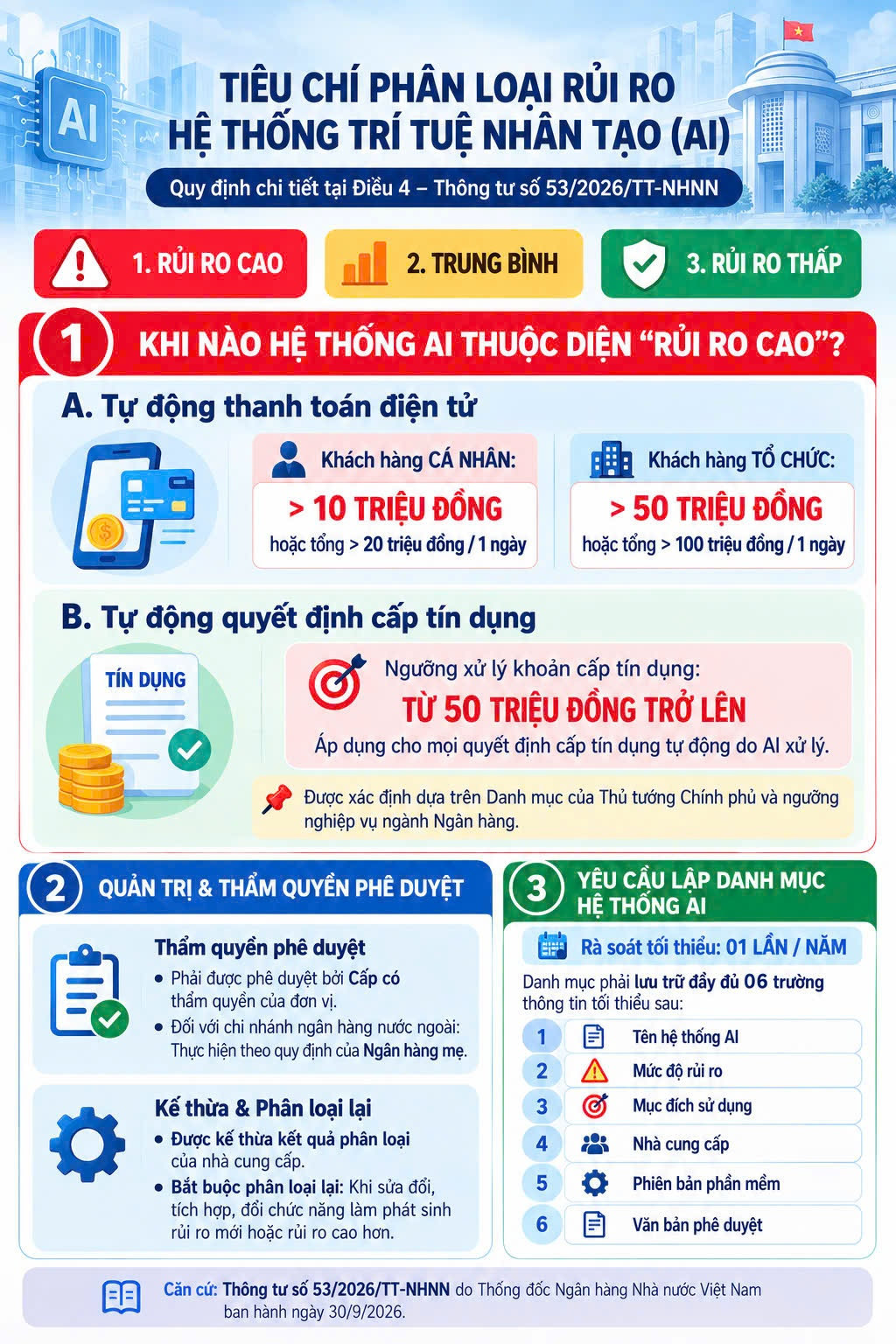
Specifically, AI systems that automatically process payment transactions are classified as high-risk if they process transactions for individual customers exceeding VND 10 million or if the total daily transaction value for a single customer exceeds VND 20 million. For institutional customers, the corresponding thresholds are over VND 50 million per transaction or over VND 100 million per day. The AI system that automatically recommends credit decisions is also classified as high-risk if the credit amount is VND 50 million or higher.
For AI to automatically execute payment transactions, the bank and the customer must have a prior agreement. The agreement must clearly specify the scope of transactions to be automatically executed, the limits per transaction and per day, the term of validity, the applicable conditions, the customer’s right to terminate the agreement at any time, and the obligation of the executing entity to immediately comply with the termination request.
The circular also sets limits on the transaction amounts that AI can automatically process. The total transaction value in a single day must not exceed the service provider’s internal limit and must not exceed VND 100 million for individual customers and VND 500 million for corporate customers. Customers must also have the means to proactively suspend or revoke the AI’s authority to automatically execute payment transactions.
In addition to transaction control requirements, the new regulations emphasize the ability for human intervention. The oversight department must have sufficient authority and capability to override, adjust, or suspend AI decisions, or activate an emergency shutdown mechanism when necessary. All interventions in the system’s decisions must be logged, including the content, time, person responsible, and reason for the intervention.
From a customer protection perspective, one key concern is the requirement for transparency when using AI for communication or decision-making. In cases where AI replaces humans in direct communication, the bank must inform customers that they are interacting with an AI system from the very beginning of the session or conversation.
Institutions must also have dedicated departments and procedures for receiving and handling complaints related to the use of AI. If an automated decision is contested by a customer, that decision must be reviewed by a human, and the result of that human review serves as the final basis for resolving the complaint.
Notably, for automated decisions that directly impact a customer’s legal liability, financial obligations, or ability to access or use products and services, the service provider must retain the basis and key factors leading to the decision so that it can be explained upon the customer’s request. However, providing an explanation does not require the disclosure of source code, detailed algorithms, parameter sets, or trade secrets and technological secrets. For decisions aimed at preventing fraud, money laundering, terrorist financing, or ensuring cybersecurity, the entity is only required to provide a rationale consistent with risk management requirements and the protection of customer assets.
The circular also devotes significant provisions to data—a factor that directly impacts the quality and safety of AI. Data used for training, testing, and operations must have a clear and lawful source; the organization must implement quality control measures to detect erroneous, inaccurate, manipulated, or poisoned data, while also monitoring changes to the data during operations.
When outsourcing to external AI providers, the ultimate responsibility still rests with the bank and the service provider. The circular stipulates that outsourcing does not alter responsibilities regarding operational safety, customer rights, cybersecurity, personal data protection, and risk management. In particular, third parties are not permitted to use the institution’s data to train, fine-tune, or improve models without prior written consent.
In the event that an outsourced AI system causes harm to customers or related parties, the service user must promptly implement remedial measures, protect customer rights, and receive, process complaints, and compensate for damages in accordance with regulations.
Circular No. 53/2026/TT-NHNN takes effect on November 15, 2026, while certain provisions regarding the risk management framework, cybersecurity audits, and human resources will be implemented according to a phased schedule. AI systems that were already in operation prior to the Circular’s effective date must comply with all safety, risk management, and deployment requirements by March 1, 2027.