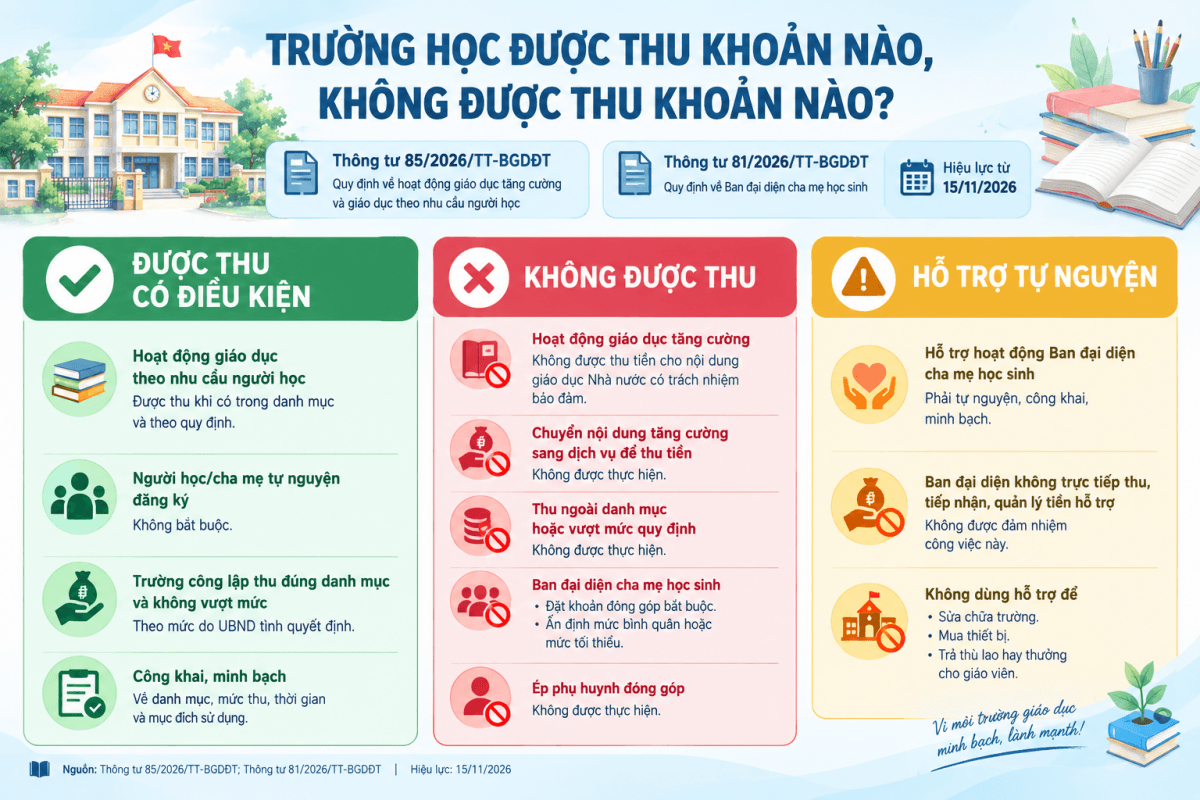

New Regulations: What Fees Can and Cannot Schools Collect?
Two new circulars from the Ministry of Education and Training, effective November 15, 2026, clearly distinguish between free educational activities and demand-based programs; they also set limits on fundraising efforts conducted through the Parent-Teacher Association. What is noteworthy is not only which fees may be collected but also that parents’ right to refuse must be respected in practice.

Distinguishing Educational Activities to Prevent Voluntary Participation from Becoming Mandatory
Many parents have expressed concerns about fee-based supplementary programs, co-curricular classes, or experiential activities promoted at schools. While families want their children to have additional learning opportunities, they also need to know which activities are essential for all students, which address specific needs, and which expenses they can decline.
In reality, the challenge goes beyond the cost. When fee-based activities are scheduled during regular class time or when the majority of students in a class participate, the decision to opt out can become difficult. Therefore, a mere notice stating “voluntary” is insufficient to prove that the right to choose has been guaranteed.
Circular 85/2026/TT-BGDĐT regulates the organization of supplementary educational activities and learner-driven educational activities at institutions implementing the General Education Program. Accordingly, supplementary education consists of basic, foundational, and essential content for students, helping to increase practice, hands-on experience, the application of knowledge, and the development of competencies. These activities are provided free of charge to students.
Schools are not permitted to separate or transfer content that falls under the State’s responsibility—including supplementary education—into demand-based programs for the purpose of generating revenue. Enhanced education does not create new subjects, does not raise curriculum requirements, and must not be transformed into forms of advance instruction, retaking courses, review, or test preparation, such as private tutoring.
Instead, demand-based educational activities stem from students’ interests, aptitudes, and individual aspirations. Families may consider foreign language, arts, sports, or other programs that align with their circumstances. These activities must be organized outside of regular school hours and supplementary education programs; participation must not be forced or subject to pressure.
Whether or not a student enrolls in such activities must not be used as a basis for evaluating academic performance, training, competitive achievements, or awards. For public schools, any fees collected must fall within the list and not exceed the limits set by the provincial People’s Committee.
Speaking to the press, Mr. Thai Van Tai, Director of the Department of General Education at the Ministry of Education and Training, stated that Circular 85 aims to standardize educational activities within schools, ensure students’ right to choose and protect their interests, while also limiting the exploitation of these activities to organize unauthorized supplementary classes.
With program names such as “Math in English,” “Supplementary English,” or “STEM Robotics,” one cannot simply look at the program name to determine whether fees may be collected. It is necessary to examine the objectives, content, target participants, and actual organization of the program. If a subject is fundamentally intended to be provided to all students, it cannot be reclassified as a “demand-based” activity to shift the cost to families.
From a governance perspective, classification must be carried out before implementation, not after parents raise concerns. Information that must be made public includes the curriculum, duration, instructors, location, fees, and alternatives for students who do not participate.
From an expert’s perspective, Dr. Vu Viet Anh, CEO of Thanh Cong Academy, believes that regular class hours should be clearly distinguished from those of affiliated programs, and that the curriculum, learning outcomes, tuition fees, and responsibilities of each party should be made public. According to him, public schools must ensure equal educational opportunities; therefore, activities that incur costs should be carefully considered to avoid placing additional pressure on students and parents.
The right to opt out must be implemented through specific arrangements. Schools should avoid situations where students who do not enroll end up lacking suitable activities, feeling isolated, or perceiving themselves as inferior to their peers.
Do Not Divide Parent Contributions Equally
In addition to academic activities, fundraising efforts through the Parent-Teacher Association are a matter of concern for many families. Disputes often arise when contributions are labeled as “voluntary” but are subject to a set average amount, a deadline for payment, or are communicated via a list.
Circular 81/2026/TT-BGDĐT promulgates the Charter of the Parent-Teacher Association, replacing Circular 55/2011/TT-BGDĐT. Under the new regulations, the Parents’ Representative Committee is not part of the school’s organizational structure and does not have legal personality, a seal, or a separate bank account. The committee’s activities must ensure voluntariness, democracy, openness, transparency, and practicality.
A notable change is that the Parent-Teacher Association is not permitted to collect, receive, or manage funds to support its own operations. When support is needed for a specific matter, the association must clearly communicate the purpose, details, requirements, and implementation plan. Parents may choose to provide support in the form of goods, services, or direct payments to the provider.
The committee is also prohibited from setting an average contribution amount, a minimum amount, or a deadline for contributions; it may not compile a list of those required to contribute or require a specific parent to do so. If available resources fall short of the plan, the activity must be adjusted in terms of content, scale, or organizational method, rather than requiring families to contribute more to make up the difference.
From a parent’s perspective, Ms. Van Anh (Hanoi) hopes that the Parent-Teacher Association will devote more time to listening to and addressing issues related to students’ academic and daily lives. According to her, when organizing activities that require support, the PTA must clearly communicate the purpose and implementation details so that each family can make its own informed decision.
“Families that choose not to contribute should not have to explain themselves or feel uncomfortable,” Ms. Van Anh shared, while expressing hope that the new regulations will help make contributions more transparent and ensure that parents’ voices are taken seriously.
Thus, the fact that a majority of parents approve of an activity does not mean that everyone must contribute financially. Families that do not participate in the contribution should not be pressured or required to explain their reasons to the group.
The regulation also draws a clear line regarding expenses that fall under the school’s responsibility. Funds raised by the Parent-Teacher Association may not be used for construction or repair of school facilities; the purchase or maintenance of equipment; the payment of salaries, bonuses, or gifts to administrators or teachers; or the payment of the school’s regular services. Fundraising activities for the school must comply with separate regulations and may not be conducted or managed through the Parent-Teacher Association.
Circular 81 also includes transitional provisions: Parent-Teacher Associations established prior to the effective date of this document may continue their operations until the end of their term.
Transparency Must Be Reflected in Implementation
The two circulars address different areas and have scopes of application that are not entirely the same. Circular 85 focuses on institutions implementing the General Education Program, while the Charter of the Parent-Teacher Association applies to both early childhood and general education institutions. However, a common thread is clarifying the school’s responsibilities and safeguarding the voluntary participation of families.
To ensure these regulations are effectively implemented, each school must review its current programs, compare their content with the new regulations, and publicly disclose its organizational plan before encouraging registration. For the Parent-Teacher Association, it is crucial to shift the focus from fundraising to listening to parents, conveying their concerns, and collaborating to ensure optimal learning conditions for students.
Education authorities also need to provide consistent guidance, monitor the classification of activities, and promptly address complaints. Fees with unclear justifications or collection methods that exert undue pressure must be rectified, rather than merely adjusting their names on paper.
This is essential for building trust between families and schools. The effectiveness of a policy is not measured solely by the number of documents issued, but also by whether parents can opt out of elective programs or financial contributions without their children facing discrimination or disruption to their education.