







Increase the standard social assistance benefit to VND 540,000 per month
The government has just issued Decree No. 335/2026/NĐ-CP dated August 21, 2026, regulating social assistance policies.
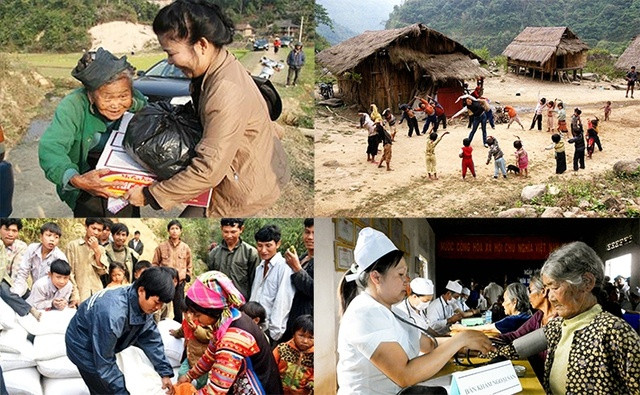
This decree regulates policies on regular community-based social assistance; community-based care and support; emergency assistance; and care and support at social assistance facilities.
The new social assistance standard, effective July 1, 2026, is VND 540,000 per month (the previous standard was VND 500,000).
Where local socioeconomic conditions permit, the provincial-level People’s Committee shall submit a proposal to the People’s Council at the same level for a decision: The social assistance standard and the social assistance amount applicable within the jurisdiction may be higher than the social assistance standard and social assistance amount specified in this Decree; Other vulnerable groups not specified in this Decree are eligible for social assistance policies.
The Decree specifies that the standard social assistance level serves as the basis for determining the social allowance amount, the level of financial support for care and support services; the level of care and support at social assistance facilities, elderly care facilities, facilities for people with disabilities, child care facilities, and other care and support facilities (collectively referred to as social assistance facilities), as well as other levels of social assistance.
Eligibility for Ongoing Community-Based Social Assistance
Article 5 of the Decree stipulates that beneficiaries of regular social assistance in the community include:
1. Children under 16 years of age who fall under one of the following circumstances:
a) Abandoned children who have not yet been adopted;
b) Children whose biological parents are both deceased, or where one parent is deceased and the other cannot be identified;
c) Children whose father or mother has died or whose whereabouts are unknown, and the surviving parent has been declared missing in accordance with the law;
d) Children whose father or mother has died or cannot be identified, and the surviving parent is receiving care and support at a social welfare facility;
e) Children whose father or mother has died or cannot be identified, and the surviving parent is currently serving a prison sentence in a detention facility or is serving an administrative penalty at a reform school, a compulsory education facility, or a compulsory drug rehabilitation center;
e) Both parents have been declared missing in accordance with the law;
g) Both parents are receiving care and support at a social welfare facility;
h) Both parents are serving a prison sentence in a detention facility or are serving an administrative penalty at a reform school, a compulsory education facility, or a compulsory drug rehabilitation center;
i) One parent has been declared missing in accordance with the law, and the other is receiving care and support at a social welfare facility;
k) One parent has been declared missing in accordance with the law, and the other parent is currently serving a prison sentence in a detention center or is serving a sentence for an administrative violation at a reform school, a compulsory education facility, or a compulsory drug rehabilitation center;
l) One parent is receiving care and support at a social welfare facility, and the other parent is serving a prison sentence in a detention center or is serving an administrative penalty at a reform school, a compulsory education facility, or a compulsory drug rehabilitation center.
2. Individuals falling under the provisions of paragraph 1 above who are receiving monthly social assistance, are at least 16 years of age, but are currently enrolled in general education, continuing education, vocational education, or undergraduate education (first degree), provided that their studies are continuous and uninterrupted (except in cases where studies are temporarily suspended or academic credits are preserved in accordance with education laws), shall continue to receive social assistance benefits until the completion of their studies.
3. Children living with HIV/AIDS from poor households.
4. Individuals classified as members of poor or near-poor households who are unmarried; or who were married but whose spouse has died or is missing as defined by law, and who are raising a child under 16 years of age (collectively referred to as poor single parents raising children).
In cases where a poor single parent raising a child is receiving monthly social assistance under the provisions of this clause, but the child has reached the age of 16 and is continuing their studies in general education, continuing education, vocational education, or a first-degree university program—provided that the course of study is continuous and uninterrupted (except in cases where studies are temporarily suspended or academic credits are preserved in accordance with education laws)—the low-income single parent raising a child shall continue to receive the monthly social allowance until the child completes their studies.
5. Elderly persons falling under one of the following categories:
a) Elderly individuals in poor households who have no one with the obligation and right to provide support, or who have someone with such obligations and rights but that person is already receiving a monthly social allowance;
b) Elderly individuals in a poor household who have no person with the duty and right to provide support, are unable to live in the community, meet the criteria for admission to a social assistance facility, but have someone providing foster care and support in the community.
6. Persons with severe disabilities and persons with exceptionally severe disabilities as defined by laws on persons with disabilities.
7. Children under 3 years of age from poor or near-poor households who do not fall under the categories specified in clauses 1, 3, and 6 above and who are living in communes or villages in ethnic minority and particularly difficult mountainous areas.
8. People living with HIV/AIDS from poor households who do not receive a salary, wages, a pension, or monthly social insurance benefits.
Monthly Social Assistance Amount
1- Beneficiaries specified in Article 5 above shall receive a monthly social assistance allowance equal to the standard social assistance rate of VND 540,000 per month, multiplied by the corresponding coefficient as follows:
a) For beneficiaries specified in paragraph 1 of Article 5 above: A multiplier of 2.5 for those under 4 years of age; a multiplier of 1.5 for those 4 years of age or older.
b) A multiplier of 1.5 for individuals specified in Clause 2 of Article 5 above.
c) For individuals specified in paragraph 3 of Article 5 above: The coefficient 2.5 applies to individuals under 4 years of age; the coefficient 2.0 applies to individuals aged 4 years or older but under 16 years of age.
d) For individuals specified in paragraph 4 of Article 5 above: The coefficient is 1.0 for each child being raised.
đ) For beneficiaries specified in Clause 5 of Article 5 above: A coefficient of 1.5 applies to beneficiaries specified in subpoint a of Clause 5 who are 60 years of age or older but under 75 years of age; a coefficient of 2.0 applies to beneficiaries specified in subpoint a of Clause 5 who are 75 years of age or older; the multiplier 3.0 applies to individuals specified in subparagraph b of paragraph 5.
e) For individuals specified in paragraph 6 of Article 5 above: The coefficient 2.0 applies to individuals with severe disabilities; the coefficient 2.5 applies to children with severe disabilities or elderly individuals with severe disabilities; the coefficient 1.5 applies to individuals with moderate disabilities; a multiplier of 2.0 for children with severe disabilities or elderly individuals with severe disabilities.
g) The coefficient 1.5 applies to the beneficiaries specified in paragraphs 7 and 8 of Article 5 above.
2. In cases where an individual is eligible for benefits at different levels under the various coefficients specified in paragraph 1 of this Article or in other documents governing social assistance programs, the individual shall receive only the highest applicable level. Specifically, low-income single parents raising children who are eligible under paragraphs 5, paragraphs 6, and paragraph 8 of Article 5 of this Decree shall be entitled to both the benefits for beneficiaries specified in paragraph 4 of Article 5 and the benefits for beneficiaries specified in paragraphs 5, 6, and 8 of Article 5 of this Decree.
Educational and Training Assistance
Eligible individuals as defined in Article 5 of this Decree who are enrolled in early childhood education, general education, continuing education, vocational education, or higher education are entitled to educational and training support policies and benefits as prescribed by law.
This Decree shall take effect on October 5, 2026.
Eligible individuals currently receiving benefits and support under Decree No. 20/2021/ND-CP dated March 15, 2021, of the Government, which stipulates social assistance policies for social welfare beneficiaries, and Decree No. 176/2025/ND-CP dated June 30, 2025, of the Government detailing and guiding the implementation of certain provisions of the Social Insurance Law, shall be transferred to the corresponding levels specified in this Decree effective July 1, 2026.
The Chair of the Commune People’s Committee shall review the list of beneficiaries currently receiving benefits and decide on payments at the corresponding rates specified in this Decree effective July 1, 2026.
The head of a social welfare facility shall organize the implementation of care and support programs and policies in accordance with the rates specified in this Decree effective July 1, 2026./.