







Investing in 2026: A Year of Selective, Disciplined, and Long-Term Investing
The investment landscape in 2026 is expected to be less “lenient”; opportunities still exist but are reserved for investors who remain steadfast in their selective, disciplined, and long-term strategies.

The investment landscape in 2026 is expected to be less “lenient,” with opportunities still present but reserved only for investors who remain steadfast in their selective, disciplined, and long-term strategies.
Looking back at 2025: a market surge, but not for everyone
2025 is considered one of the most dynamic periods in the financial market, as most asset classes surged simultaneously, creating a widespread sense that “money was easy to make.” In the stock market, the VN-Index rose 40.9% by December 31 compared to the end of 2024, setting a new all-time high. The upward momentum pushed valuations higher, with the market-wide P/E ratio reaching 17.6 times, far exceeding the average of 15.2 times from two years prior. However, the index’s surge does not equate to success for the majority of investors. According to assessments by securities firms, over 90% of individual accounts in 2025 either broke even or achieved returns of less than 10%. Capital flowed primarily into a few leading stocks, while the majority of investors found themselves in a “beat the index, lose on the portfolio” situation due to chasing prices at high levels, following short-term trends, and lacking discipline.
Gold also drew significant attention as global prices rose by 64.6%, while domestic prices surged by 81.5%. However, this surge came with significant risks as the price gap between domestic and global markets widened to 15.8 million VND per tael by year-end, amid the State Bank of Vietnam’s suspension of intervention sales starting in September 2025. Despite high prices, demand for gold continued to surge, raising concerns about the risk of “buying at the peak” as the trend reverses.
The residential real estate market also saw sharp price increases: apartment prices rose by 20–30%, with some areas exceeding 40%; townhouses and villas increased by 10–20%; and land plots rose by approximately 20–25%. Supply and transactions improved thanks to resolved legal issues and favorable interest rates. However, starting in late 2025, prices began to level off, with localized loss-cutting in apartments and reduced liquidity in land plots in localities experiencing overheated growth due to merger-related news.
On the other hand, the deposit channel—which had been “lagging behind” for most of 2025—began showing signs of change toward the end of the year. After a prolonged period of stagnation, listed deposit rates began to rise again starting in early November 2025 at most commercial banks. By year-end, the 12-month deposit rates across bank groups ranged from 5.2% to 5.74% per year. The rise in listed deposit rates toward the end of the year reflects increased demand for capital to meet the State Bank of Vietnam’s liquidity safety targets and is both temporary and localized.
Overall, 2025 was a year of strong asset price growth but not one where the majority of investors emerged victorious. The deep polarization in investment performance laid the groundwork for a new phase, where discipline and selectivity have become key factors.
Rising interest rates increase screening pressure on investments
Moving into 2026, the investment landscape is projected to shift toward a more balanced state. According to a report by the BIDV Economic Research Institute, the listed deposit interest rate for a 12-month term could range from 5.5% to 6.2% per year, barring any unusual fluctuations. The rise in listed interest rates is primarily driven by rising inflation expectations in 2026, following a significant increase in credit growth in 2025.
Against the backdrop of rising interest rates and macroeconomic risks that have not yet fully subsided, the investment environment in 2026 is expected to be less “lenient” than in the previous period. This places higher demands on asset selection, as well as a cautious and disciplined approach to investment strategy. In this context, deposit accounts are expected to remain the preferred choice for investors with a conservative to moderate risk appetite.
Positive outlook for financial assets but with high divergence
For the stock market, the outlook for 2026 remains positive but is accompanied by a high degree of divergence. The VN-Index is expected to maintain an upward trend driven by three key factors: continued expansion of fiscal policy and accelerated public investment; high economic growth supporting the profits of listed companies; and market reforms aimed at upgrading the stock market’s status and launching new products to attract long-term capital. 2026 is also expected to see a continued expansion of the IPO wave, with many high-profile companies anticipated to list, such as Dien May Xanh, LPBS Securities, and HoaSen Home,…
However, amid rising interest rates and unpredictable external risks such as geopolitical tensions, U.S. economic growth, or tariff issues, the market is unlikely to rise uniformly but will likely focus on companies with strong fundamentals, sustainable profit growth, and reasonable valuations.
“Rising interest rates lead to higher required returns from investors for risky investment channels like stocks, making investment selection highly selective and differentiated, focusing on stocks of companies with sustainable profit growth and reasonable valuations,” the report from the BIDV Economic Research Institute states.
Alongside stocks, the corporate bond market is projected to continue its recovery in 2026 as corporate capital needs increase. Bond yields may be higher than in 2025, but in return, issuance standards and information transparency will be enhanced, helping the market recover more effectively and sustainably.
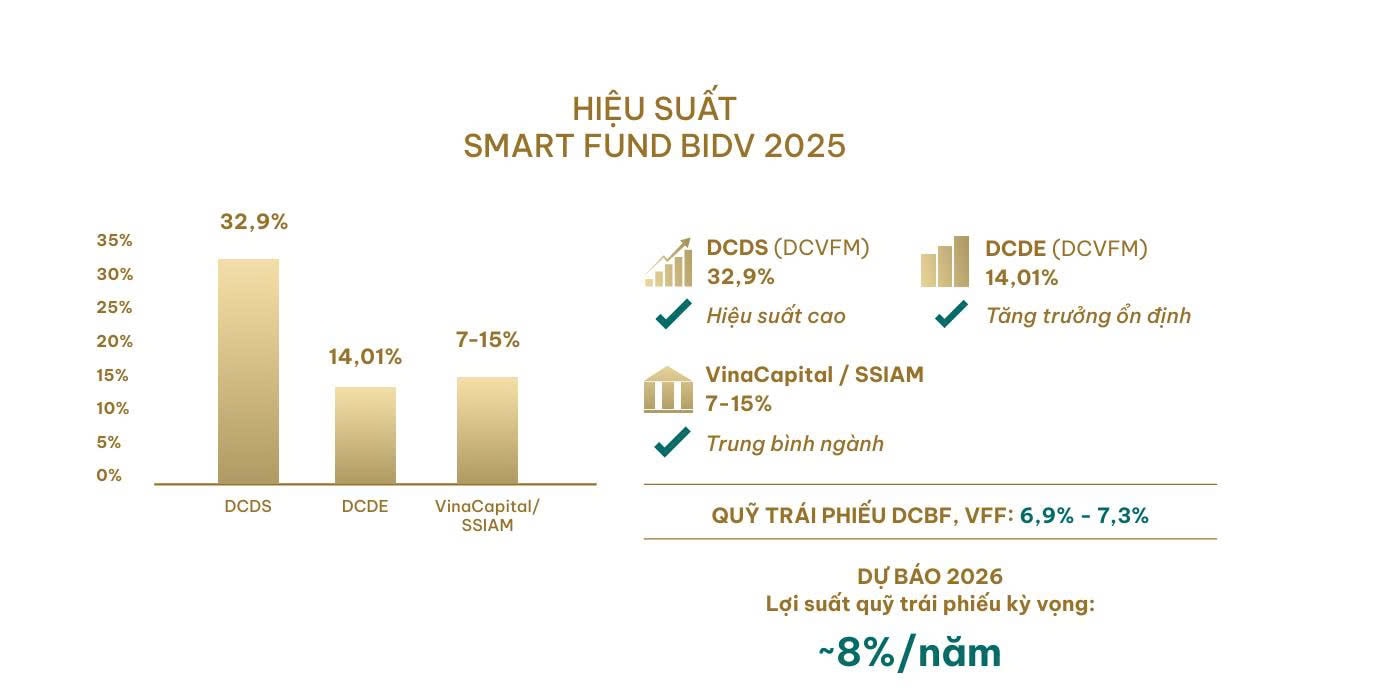
Amid significant market polarization, investing through open-end funds continues to play a crucial role for long-term investors. In 2025, the Smart Fund portfolio offered to high-net-worth clients at BIDV recorded relatively positive results. Dragon Capital’s (DCVFM) fund group stood out with the DCDS fund achieving a return of 32.9% and the DCDE fund achieving 14.01%, thanks to a flexible investment strategy and proactive portfolio restructuring. Meanwhile, funds managed by VinaCapital and SSIAM also achieved average returns of approximately 7–15%.
On a more stable note, medium- and long-term bond funds such as DCBF and VFF maintained yields around 6.9–7.3% in 2025. According to assessments by some experts in the fund management industry, in 2026, as the supply of corporate bonds increases and interest rates rise slightly, the expected yields of bond funds may improve, reaching around 8% per year.
Caution with defensive and tangible assets
In the gold market, experts from the BIDV Economic Research Institute forecast that the upward trend will continue in 2026, driven by safe-haven demand amid global geopolitical and economic uncertainties, most recently the U.S. campaign in Venezuela. High global public debt, coupled with the trend of central banks increasing their gold reserves—particularly China—continues to provide a supportive foundation for prices. However, the risk associated with this investment channel is that it has already experienced a sharp price surge in 2025, leading to a more cautious outlook on investing in this precious metal.
Regarding real estate, 2026 is viewed as a phase of recovery toward greater sustainability. The housing market continues to benefit from the commitment to promoting economic growth, improving the legal framework, and investing in infrastructure, though these efforts are being regulated in a phased manner to avoid shocks. Policies to control input costs, regulate supply—particularly for social housing—and enhance transparency are expected to help stabilize the market while curbing speculation and price inflation seen in previous phases.
Overall, 2026 presents an investment environment that still offers opportunities but requires a more cautious approach. As interest rates rise slightly and macroeconomic risks have not yet fully subsided, investment strategies cannot rely on “market momentum” but must focus on asset quality, risk management, and capital allocation discipline—factors that are decisive for long-term investment performance.
In the gold market, experts from the BIDV Economic Research Institute forecast that the upward trend will continue in 2026, driven by safe-haven demand amid global geopolitical and economic uncertainties.
Anh Thư