







New Year's red envelopes: From a beautiful custom to the civilized use of money
As the traditional Tet holiday approaches, when social transactions become more vibrant than ever, the story of money usage is no longer purely an economic transaction issue, but is closely tied to cultural values, customs, and human behavior.
At a seminar titled "Civilized Money Use and Secure Payments During Tet," historian Duong Trung Quoc shared many insightful perspectives on the custom of giving red envelopes—a familiar practice that also raises many issues in modern life.
According to Mr. Duong Trung Quoc, broadly speaking, the topic of using money during Tet can be divided into three elements: money - which falls within the scope of banking; secure payment - which is linked to social management; and the element of civility - where cultural values, traditions, and human behavior are most clearly expressed. Among these, the custom of giving red envelopes is a prime example of the intersection between economics and culture, tradition and modernity.
Lì xì, in terms of its origin, is not a foreign concept to many Asian societies. The term "lì xì" was previously popular in the South, where there is a large Chinese community. According to historian Duong Trung Quoc's explanation, "lì xì" in Han Viet is "lợi thị", meaning good fortune and luck in life.
The most familiar form of lì xì is the "red envelope" - a red envelope, a color symbolizing prosperity, luck, wealth, and fortune, very suitable for the atmosphere of spring, the beginning of a new cycle in nature and in human life.
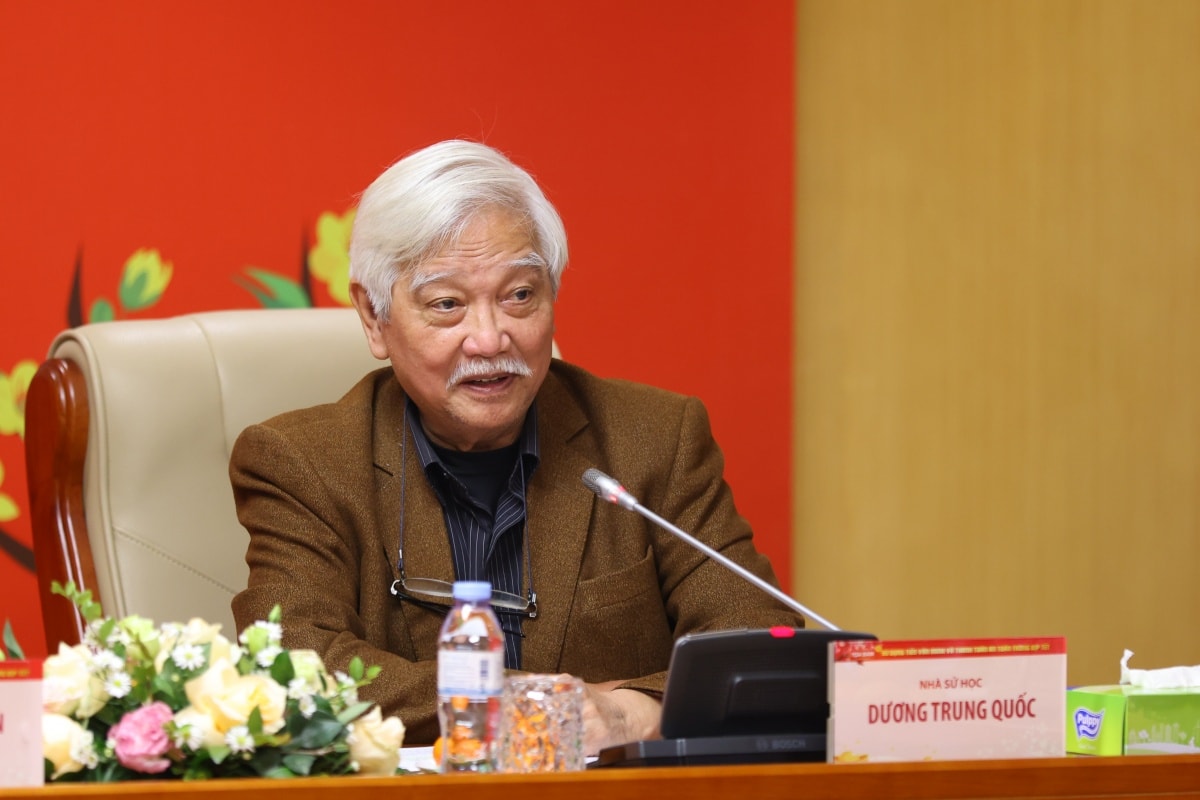 |
| Historian Duong Trung Quoc: Lì xì is the product of a long historical process, capable of self-filtering and adaptation. The issue is not about mechanically eliminating or maintaining it, but about understanding its core values correctly, so that these beautiful customs can continue to exist in harmony with modern life. |
However, in Vietnamese tradition, the concept closest to lì xì is "mừng tuổi" (celebrating one's age). Each year, as people add another year to their age, they enter a new stage of life. Mừng tuổi is primarily directed at children, as a form of encouragement and initial education to help them engage with social life. Gradually, the scope of this custom has expanded, no longer limited to elders giving lì xì to juniors, but also extending to the reverse, and then to friends, colleagues, and society giving lì xì to one another.
It is precisely because of this expansion that, according to Mr. Duong Trung Quoc, giving money is no longer just a source of excitement for children but has become a concern for the whole society. In this concern, money plays a central role, and all movements of money, whether in cash or electronic form, are linked to the activities of the banking system in the economy.
From a historical perspective, money in traditional Vietnamese society did not circulate strongly. Rural society was closed, with transactions mainly taking place within a narrow scope, often self-sufficient and self-sufficient. In that context, celebrating the New Year did not necessarily involve money, but could be in the form of goods or local products. Only when money increasingly penetrated life and became the core of economic transactions did it take center stage in the custom of giving red envelopes.
As money increasingly plays a vital role in conveying good luck, wishes, and social relationships, the custom of giving red envelopes also faces certain changes. Good luck is expressed through a very material element, but it is placed within increasingly complex social relationships. In this context, this custom is both a way of expressing care and affection, and can also give rise to expressions that deviate from the original meaning.
According to historian Duong Trung Quoc, this is not only true for red envelopes but is also evident in how people use small change, merit money, or money in spiritual spaces. In traditional society, the concept of "ferry money" reflects a reality: transportation was mainly by river, all travel incurred costs, and those costs had to be divided according to each person's financial ability. From there, the need for small change arose. Economically, small change may no longer have great value, but in cultural life, it carries meaning associated with customs.
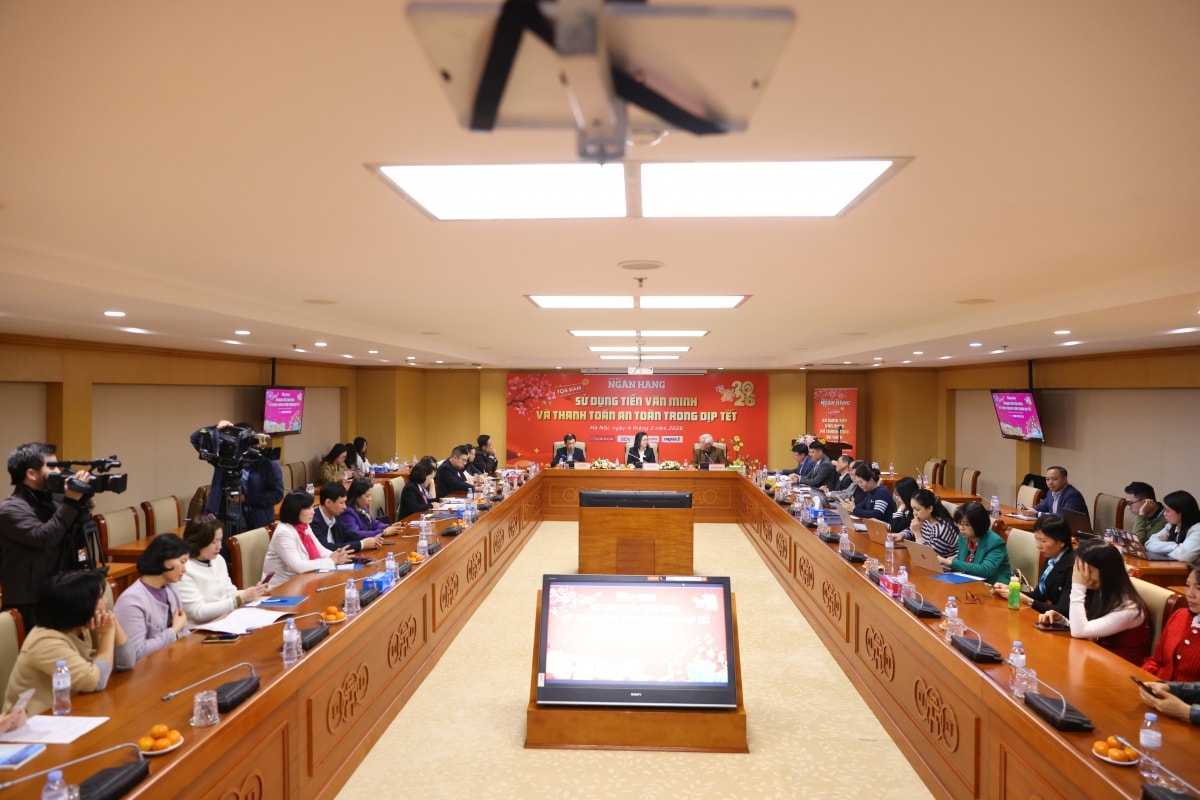 |
| Scene from the Roundtable Discussion "Civilized Money Use and Safe Payments During Tet" |
However, according to Mr. Duong Trung Quoc's observations, the process of using small change has gradually strayed from its original values. In Buddhism, the practice of "stuffing money into statues' hands" or placing money indiscriminately on offering tables does not exist in Buddhist teachings. The Buddhist Church has also spoken out about this issue many times. In reality, correcting these deviations does not depend on one side alone, but involves those who perform the rituals, believers, Buddhists, and even the religious institutions themselves.
Therefore, historian Duong Trung Quoc believes that these issues cannot be resolved by law alone. For behaviors that directly affect public life, such as scattering money on the road during funerals, legal sanctions are needed to prevent them. But for many other behaviors, the core issue remains education from the receiving side and from the practitioners themselves.
In the context of modern society, along with technological development, the form of red envelopes is also changing. Electronic red envelopes offer convenience in management and transactions. But according to Mr. Duong Trung Quoc, the question is whether this form can fully convey emotions. Because emotion is one of the important elements of cultural behaviors. If it is just a dry money transfer transaction, then electronic red envelopes are no different from other transactions in economic life.
But according to him, tradition does not mean staying the same. The important thing is to make tradition relevant to the times, while still retaining its core values. If modern forms of red envelopes can be accompanied by wishes, images, or messages with special meaning, then the recipient can still recognize the cultural significance of this custom, rather than just a number in an account.
From red envelopes and small change to New Year customs such as Vía Thần Tài, Mr. Duong Trung believes that the issue lies not only in the form, but also in how society perceives and treats money. According to this historian, the desire to get rich is legitimate, but it is important to get rich within the framework of values recognized by society. He believes that the credibility of money and the banking system plays an important role in guiding how society behaves towards traditional customs, thereby helping to limit distorted manifestations.
Along with that, customs such as giving red envelopes are the product of a long historical process, capable of self-filtering and adapting. The issue is not to mechanically eliminate or maintain them, but to understand their core values correctly, so that these customs can continue to exist in a way that is appropriate for modern life.