







Notable Directives and Decisions by the Government and the Prime Minister for the Week of August 1–7
Building and developing Vietnam into a strong maritime nation; key tasks for the 2026–2027 school year... were among the notable policy directives and administrative decisions issued by the Government and the Prime Minister during the week of August 1–7, 2026.
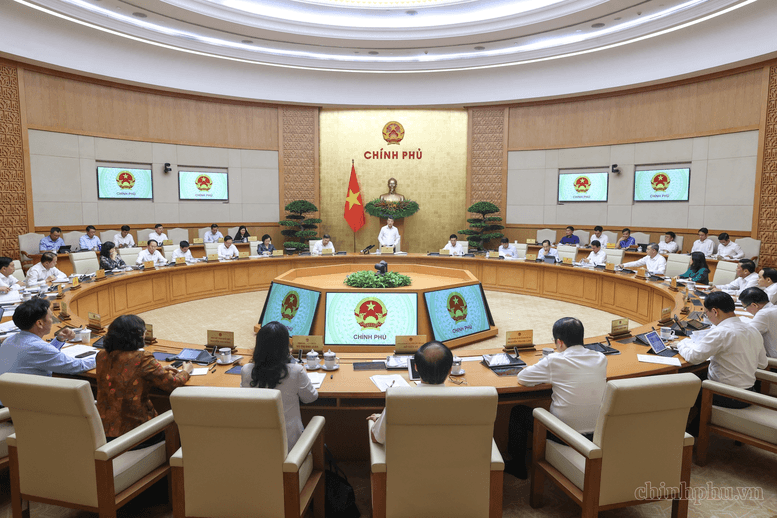
Resolution of the Regular Government Meeting for July 2026
The Government issued Resolution No. 216/NQ-CP following the regular Government meeting in July 2026.
In the Resolution, the Government instructs ministries, sectors, and localities to carry out several key tasks, including: Promoting growth in tandem with macroeconomic stability; striving to increase state budget revenue in 2026 by at least 10%; accelerating the progress of key national and priority infrastructure projects; expanding the provision of end-to-end online public services and the application of big data and artificial intelligence; and thoroughly preparing for key foreign affairs activities from now until the end of 2026...
Building and developing Vietnam into a strong maritime nation
The Government issued Resolution No. 218/NQ-CP on August 7, 2026, on the Government’s Action Program to implement Resolution No. 20-NQ/TW dated July 28, 2026, of the Third Plenum, of the 14th Central Committee of the Party on building and developing Vietnam into a strong maritime nation (the Program).
The Government requires ministries, ministerial-level agencies, and People’s Committees of provinces and centrally-affiliated cities to proactively develop plans and vigorously, comprehensively, and effectively implement the following nine tasks:
1- Innovate thinking, raise awareness regarding the development of a strong maritime nation, and enhance the effectiveness and efficiency of national maritime governance.
2- Improve the institutional framework and reform national maritime spatial planning to create a breakthrough in the development of a strong maritime nation.
3- Mobilize, harness, and effectively utilize resources; vigorously develop maritime enterprises, particularly large-scale corporations and conglomerates.
4- Develop science, technology, innovation, digital transformation, and a high-quality workforce.
5- Achieve breakthroughs in the development of modern, green, and smart marine economic sectors, as well as new marine economic sectors.
6- Develop marine infrastructure in a coordinated manner, expand the nation’s development space, and establish marine economic centers.
7- Protect the environment and conserve marine ecosystems; proactively adapt to climate change; and enhance the resilience of coastal and island localities.
8- Foster a maritime culture, improve people’s livelihoods, and harness the strength of coastal and island communities in building and defending the nation.
9- Ensure national defense, security, and safety at sea and on islands; strengthen international integration and cooperation; and enhance the nation’s standing.
Criteria for Classifying Enterprises for the Restructuring of State Capital in Enterprises
Deputy Prime Minister Nguyen Van Thang signed Decision No. 40/2026/QD-TTg dated August 5, 2026, issued by the Prime Minister, regarding criteria for classifying enterprises to restructure state capital in state-owned enterprises and enterprises with state capital.
The decision specifies that the criteria for classifying state-owned enterprises by industry and sector, as well as the framework for the proportion of state capital held in enterprises for the purpose of reorganizing state capital, are defined as follows:
Enterprises in which the State holds 100% of the charter capital and that operate in the following industries and sectors: Enterprises providing essential public goods and services to society; enterprises operating in sectors with natural monopolies; science and technology enterprises as defined by laws on science, technology, innovation, and digital transformation; enterprises constructing key national infrastructure projects in the fields of transportation, water resources, energy, and digital infrastructure as specified in Decree No. 366/2025/NĐ-CP; high-tech enterprises; enterprises operating in key and essential sectors of the economy…
Enterprises that are undergoing reorganization or restructuring of state-held equity constituting 65 percent or more of their authorized capital and that operate in the following industries and sectors: management and operation of airports and air transport; management and operation of port terminals at special seaports; large-scale mineral extraction; production of animated films commissioned or funded by the State; finance and banking; mechanical engineering; enterprises ensuring essential needs for production development and improving the material and spiritual lives of ethnic minority communities in mountainous, remote, and isolated areas; and the production, supply, and management of clean water and urban and rural drainage systems…
Enterprises undergoing capital restructuring, in which the state holds more than 50% but less than 65% of the charter capital, operating in the following industries and sectors: Petroleum import hubs holding a market share of 30% or more, which play a role in ensuring major economic balances and stabilizing the market; telecommunications service providers of special importance to the national telecommunications infrastructure, directly impacting socioeconomic development and ensuring national defense and security; and companies engaged in the exploration, appraisal, and assessment of mineral reserves (excluding oil and gas).
Conditions for Establishing a Commodity Exchange
The Government issued Decree No. 302/2026/NĐ-CP, which details certain provisions and enforcement measures of the Commerce Law regarding the trading of commodities through a Commodity Exchange.
The Decree stipulates that enterprises applying to establish a Commodity Exchange must meet the following conditions:
1. The enterprise must be established in Vietnam; in the case of a foreign-invested enterprise, the total proportion of capital contributed by foreign investors must not exceed 49%.
2. Have a charter capital of at least VND 1.5 trillion.
3. Possess an information technology system that meets the requirements for safe, stable, and secure management and operation.
4. Have a business model and organizational structure for a commodity exchange, as well as solutions and a roadmap for listing commodities produced in Vietnam.
5. Have a draft charter of operations that complies with the provisions of Article 13 of this Decree.
Approval of the Special National Program on Science, Technology, and Innovation for Strategic Technologies
Deputy Prime Minister Ho Quoc Dung signed Decision No. 1493/QD-TTg on August 6, 2026, approving the Special National Program on Science, Technology, and Innovation for Strategic Technologies (the Program).
The Program’s overarching objective is to master, develop, refine, and commercialize strategic technology products with high competitiveness, gradually integrating into the global value chain; to develop strategic technologies, particularly core technologies; to establish a strategic technology ecosystem, strengthen collaboration among the government, businesses, and science and technology organizations, and contribute to enhancing the nation’s technological self-reliance and competitiveness.
Approval of the Project on Developing a Key Research and Testing System for Strategic Technologies
Deputy Prime Minister Ho Quoc Dung signed Decision No. 1483/QD-TTg dated August 4, 2026, issued by the Prime Minister, approving the Project “Development of a System of Research, Testing, National Key Laboratories, Focusing on Strategic Technologies.”
The objective of the Project is to develop a system of modern, integrated, interconnected, and shared national key research, testing, and laboratories across the country, focusing on strategic technologies, core technologies, and strategic technology products; with certain fields reaching advanced levels in the region and approaching the levels of developed countries. Gradually establish national capabilities in research, testing, measurement, inspection, conformity assessment, pilot production, and technology commercialization…
Methods for Mobilizing the Potential of Individual Citizens to Support the Activities of the People’s Public Security Forces
The Government issued Decree No. 304/2026/NĐ-CP on August 3, 2026, on mobilizing scientific, technological, and technical resources to support the operations of the People’s Public Security Forces.
3. A decision by the Prime Minister assigning the Ministry of Public Security and the agencies or organizations possessing scientific, technological, and technical resources. This mobilization method applies only to public assets entrusted to agencies or organizations for management and use, and may be used only when the mobilization methods specified in clauses 1 and 2 above cannot be implemented. The Ministry of Public Security shall report to the Prime Minister for consideration and a decision on the application of this mobilization method.
Key Tasks for the 2026–2027 Academic Year
The Prime Minister issued Directive No. 31/CT-TTg on August 5, 2026, on the implementation of key tasks for the 2026–2027 school year.
In the directive, the Prime Minister requires the Ministry of Education and Training to reform the assessment and evaluation process to ensure it is substantive and effective; reduce exam-related pressure; strengthen discipline and order in schools; strengthen measures to prevent and combat cheating in exams, particularly in the High School Graduation Exam, and strictly handle violations in accordance with regulations. Direct and guide local authorities to review and eliminate unnecessary exams and competitions; reduce pressure on students, teachers, and parents...
Ensure that the first day of school is truly a celebration for students and teachers
Deputy Prime Minister Le Tien Chau signed Decision No. 1472/QD-TTg issuing the Implementation Plan for the conclusions of the General Secretary, President To Lam at the working session on preparations for the 2026–2027 school year and the status of implementing Politburo Resolution No. 71-NQ/TW dated August 22, 2025, on breakthroughs in the development of education and training (the Plan).
One of the tasks set forth in the Plan is for the Ministry of Education and Training to take the lead, in coordination with relevant ministries, agencies, and localities, in thoroughly reviewing issues related to ensuring learning conditions for students, such as: classrooms, specialized classrooms, textbooks, minimum teaching equipment, clean water, restrooms, electricity, internet access, school safety, and students at risk of dropping out... Localities are encouraged to proactively use local budgets and other lawful resources in accordance with regulations to provide practical support to students in the new school year, especially those in areas with difficult or particularly difficult socioeconomic conditions, as well as in industrial zones and export processing zones; Focus on providing support for school lunches, half-day meal programs, educational equipment, school supplies, and transportation for students. Resolutely ensure that no student is prevented from attending school due to difficult circumstances...
Structure, Number, and Regulations Regarding Principals and Vice Principals Upon School Mergers
The Government has just issued Resolution No. 37/2026/NQ-CP on the structure, numbers, and certain policies regarding principals, directors, vice principals, vice directors, and educational support staff when reorganizing public preschool, general education, continuing education, and vocational education institutions at the provincial and commune levels.
Regarding the structure, number, and retention of position allowances for principals, directors, vice principals, and vice directors, the Resolution stipulates:
1- Principal or Director: Each educational institution shall have one principal or one director.
2- Vice principal or deputy director:
a) For early childhood education institutions, general education institutions, and continuing education centers: The main campus is allocated one vice principal or one deputy director; each branch campus is allocated one vice principal or one deputy director;
b) For intermediate schools and vocational high schools: The number of vice principals shall be determined in accordance with legal provisions regarding the number of deputy positions;
c) For vocational and continuing education centers: The main office shall have one deputy director, and each branch shall have one deputy director.
3. After reorganization in accordance with provisions 1 and 2 of this section, the remaining principals, directors, vice principals, and vice directors of educational institutions prior to reorganization shall be assigned as follows:
a) They shall be assigned to teaching positions or other positions appropriate to the professional competence, expertise, and field of training of the principals, directors, vice-principals, and deputy directors following the reorganization;
b) If the number of remaining principals, directors, vice principals, and vice directors after the reorganization meets the requirements specified in subparagraph a above and they wish to resign, their cases shall be handled in accordance with the workforce reduction policies set forth in Decree No. 154/2025/ND-CP dated June 15, 2025, issued by the Government, which regulates workforce reduction.
4. In cases where principals, directors, vice principals, or vice directors cease to hold their positions or are appointed to new positions with lower position allowances as a result of the reorganization of educational institutions, they shall retain their leadership position allowances in accordance with the provisions of Article 11 of Decree No. 178/2024/ND-CP dated December 31, 2024, of the Government on policies and regulations for officials, civil servants, public employees, workers, and the armed forces in the implementation of organizational restructuring of the political system (as amended and supplemented by Decree No. 67/2025/ND-CP dated March 15, 2025).
Policies to support and encourage businesses to participate in vocational education activities
The Government issued Decree No. 308/2026/ND-CP dated August 5, 2026, detailing certain provisions of the Vocational Education Law regarding State support policies for businesses and corporate workforce training funds.
The Decree stipulates several support and incentive policies to encourage businesses to participate in vocational education activities, such as: The State encourages businesses to collaborate with vocational education institutions to research and apply science, technology, and innovation; technology transfer; and promoting digital transformation and green transformation in vocational education and skills development; providing training funding to businesses when they provide entry-level training for vulnerable groups; and training in priority or hard-to-socialize fields and occupations...
Policies for Respected Individuals in Ethnic Minority Communities
In Decree No. 307/2026/NĐ-CP, the Government details policies for respected individuals in ethnic minority communities, including: policies on information support; policies on material support and moral encouragement; reward policies; and reception policies.
The Decree stipulates that provincial and municipal People’s Committees shall direct and organize the implementation of policies to provide material support and moral encouragement to respected individuals, such as:
- Visiting and presenting gifts on the occasion of the Lunar New Year, other holidays, or traditional festivals of ethnic minority groups; up to three times per person per year; at a rate of VND 1,000,000 per person per visit.
- Visiting and providing support to respected individuals who are ill, no more than once per year. The actual expenditure amount, up to a maximum of: VND 5,000,000 per person for treatment at specialized medical facilities; VND 3,000,000 per person for treatment at basic medical facilities; VND 1,000,000 per person for treatment at primary care facilities…
Procedures for Receiving and Processing Administrative Procedures in an Electronic Environment
Decree No. 310/2026/NĐ-CP stipulates the process for receiving and processing administrative procedures in an electronic environment as follows:
1. The National Public Service Portal receives requests and performs automatic technical checks. If the application is complete and meets technical requirements, the system automatically confirms that the organization or individual has successfully submitted it and notifies them of the time the system received the application.
2. Officials, civil servants, and public employees who receive applications shall log in to the Administrative Procedure Processing Information System and review the electronic documents submitted by organizations and individuals.
3. After verification, if the conditions for acceptance are met, officials, civil servants, and public employees shall accept and process the documents in accordance with the procedures specified in Chapter III of Decree No. 118/2025/NĐ-CP and relevant legal provisions.
4. The information and application components listed in Section 2 above, after being accepted by the competent authority and verified for accuracy, shall be stored in the electronic data repository of the organization or individual within the Administrative Procedure Processing Information System.
5. The receipt and processing of administrative procedures for the proactive provision of online public services shall be carried out in accordance with the provisions of the Digital Transformation Law, the Data Law, and the detailed regulations and guidelines for the implementation of these Laws.
Proactively Responding to Climate Change in the New Era

The Government issued Resolution No. 208/NQ-CP on the Government’s Action Plan to implement Conclusion No. 75-KL/TW dated July 28, 2026, of the Central Committee of the Party, 14th Term, on environmental protection and proactively responding to climate change in the new era.
The program outlines nine measures for proactively responding to climate change in the new era, including: 1- Raising awareness, educating the public, fostering consensus in understanding and action, and mobilizing the participation of the entire society in environmental protection and climate change response; 2- Improving institutional frameworks, policies, and laws; enhancing the effectiveness and efficiency of enforcement; 3- Mobilizing, allocating, and effectively utilizing resources; 4- Addressing pressing environmental issues; preventing and controlling pollution; and improving environmental quality; 5- Conserving nature and biodiversity, and using natural resources efficiently; 6- Proactively adapting to climate change and mitigating natural disaster risks; 7- Promoting green transition, developing a circular economy and a low-carbon economy, and strengthening the management of greenhouse gas emissions; 8- Developing science and technology, fostering innovation, advancing digital transformation, and strengthening human resources; 9- Promoting international cooperation and integration.
Amendments and Additions to the Conditions for Establishing Industrial Clusters
The Government issued Decree No. 303/2026/ND-CP dated August 1, 2026, amending and supplementing certain articles of Decree No. 32/2024/ND-CP dated March 15, 2024, of the Government on the management and development of industrial clusters.
Regarding the conditions for establishing industrial clusters: To align with the two-tier local government model, to ensure the feasibility of establishing and investing in the construction of industrial clusters, to provide land resources for the development of the private sector and local economic growth, and to ensure the efficient use of land, Decree No. 303/2026/ND-CP has amended and supplemented the conditions for establishing industrial clusters under Point c, Clause 1, Article 8 of Decree No. 32/2024/ND-CP as follows: "In cases where an industrial cluster has already been established at the commune level, the average occupancy rate of the industrial clusters must exceed 50 percent, or the total un leased industrial land area of the industrial clusters must not exceed 50 hectares."
Establishment of the Hung Yen Province High-Tech Park
Deputy Prime Minister Ho Quoc Dung signed Decision No. 1499/QD-TTg establishing the High-Tech Zone under the People’s Committee of Hung Yen Province, to be known as the Hung Yen Provincial High-Tech Zone; it covers an area of 496.1 ha, located within the communes of Hoan Long and Viet Yen, Hung Yen Province.
The Hung Yen Provincial High-Tech Zone is tasked with carrying out high-tech activities in accordance with Vietnam’s high-tech development policies; conducting research, application, and development of high-tech and strategic technologies; manufacturing high-tech and strategic technology products; providing high-tech and strategic technology services; supporting the incubation, training, and transfer of high-tech and strategic technologies; and carrying out other tasks and functions of the high-tech zone as prescribed by law on high technology.
Action Plan for the Prevention and Mitigation of Storms, Floods, Extreme Natural Disasters, and Climate Change
The Government issued Resolution No. 201/NQ-CP on the Action Plan to Implement the Conclusions of the General Secretary, President of the State, as set forth in Notice No. 117-TB/VPTW dated July 4, 2026, issued by the Central Office of the Party regarding efforts to prevent and respond to typhoons, floods, extreme natural disasters, and climate change.
According to the Plan, from now until the end of 2026, the Ministry of Agriculture and Environment will develop and submit to the Prime Minister for issuance the National Disaster Prevention and Mitigation Plan for the 2026–2030 period; update disaster scenarios and issue impact-based warnings.
It will direct efforts to ensure the safety of dikes and reservoirs; proactively respond to droughts, saltwater intrusion, flash floods, and landslides; improve the quality of forecasts and warnings; and shift strongly from warning about phenomena to warning about impacts, with details tailored to each specific area.
The Ministry of Agriculture and Environment shall take the lead, in coordination with relevant localities, in reviewing, prioritizing, and finalizing the project list to ensure the implementation of tasks and environmental protection projects, and proactively adapt to climate change as part of the initiatives led by the Ministry of Agriculture and Environment under the Central Committee’s Action Program to implement the Resolution of the 14th National Party Congress.