







US-Israel and Iran Tensions: Not Just Rising Oil Prices – What's Quietly Impacting the Market?
As Middle East tensions escalate, the first thing the market typically sees is rising oil prices and soaring transportation costs.
According to BSC Research, tensions in the Middle East could increase caution in global financial markets, driving capital flows toward safe-haven assets like gold, bonds, and the US dollar. The upward trend of the US Dollar Index (DXY) could thus put pressure on the USD/VND exchange rate, thereby affecting the room for monetary policy adjustment and domestic interest rate levels.

Transit through the Strait of Hormuz accounts for 30% of global oil trade and 20% of global liquefied natural gas (LNG) trade. Saudi Arabia is the largest oil exporter through the strait, while Qatar leads in LNG exports.
Transport volume through the strait in 2024 (daily average): Oil & oil products: 20.3 million barrels; LNG: 290 million cubic meters, of which 80% of the world's LNG passes through the Strait of Hormuz, mainly to Asia, and 20% to Europe.
Immediately after the United States and Israel opened fire on February 28, 2026, the number of cargo ships passing through the Strait of Hormuz dropped sharply. The number of ships may continue to decline during the campaign after Iran officially announced the closure of the Strait of Hormuz on March 2 and only allowed Chinese ships to pass through.
The BDTI index, which represents global crude oil transportation costs, skyrocketed immediately after the outbreak of hostilities. The conflict in the Middle East not only affected transportation through the Strait of Hormuz but also affected transportation through the Suez Canal and the Red Sea, causing ships to change their routes, increasing transportation time and costs.
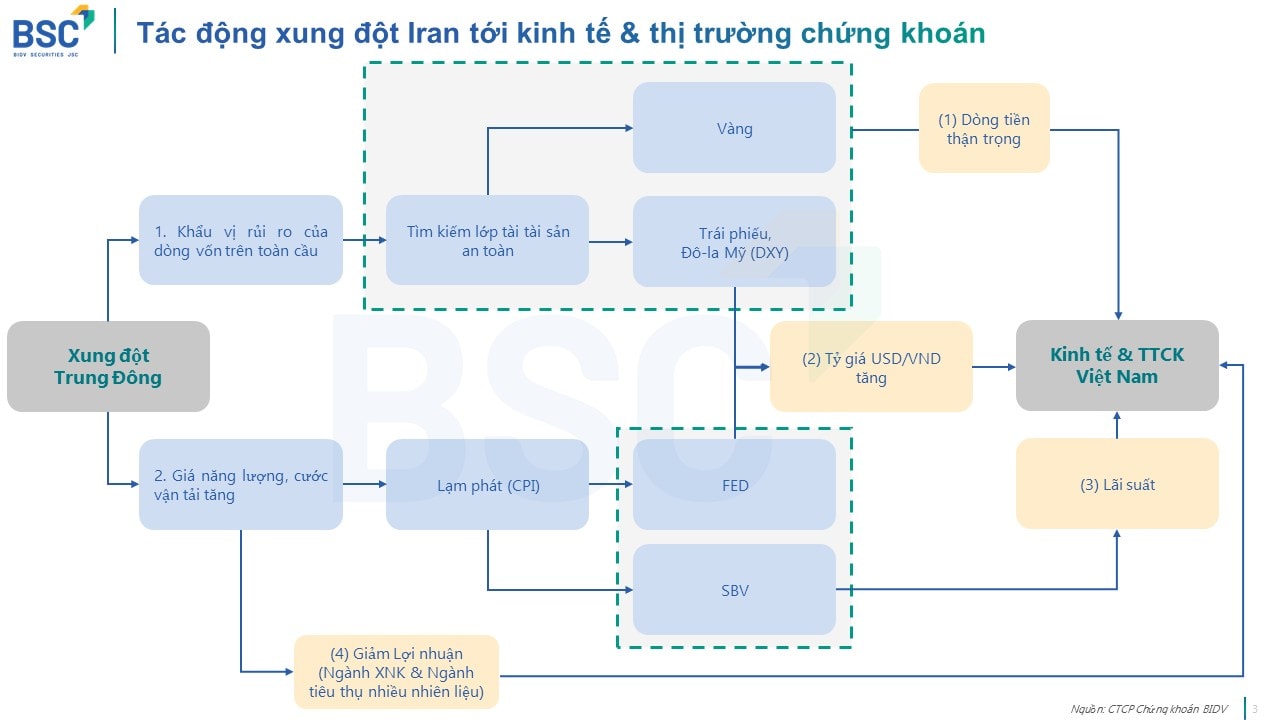
For the Vietnamese stock market, the impact will vary by industry group. The oil and gas and fertilizer sectors are expected to benefit directly from rising energy prices. Meanwhile, industries that consume large amounts of fuel or depend on imported inputs may face cost pressures. In addition, import and export businesses may also face risks of supply chain disruptions and increased transportation costs.
From a logistics perspective, changes in global energy transport routes may extend transport distances, increase vessel turnaround times, and create supply-demand imbalances in the maritime transport industry.
For detailed tracking of the "Industry Impact Matrix by Conflict Scenarios": Download the report
Source: BIDV Securities (BSC)